
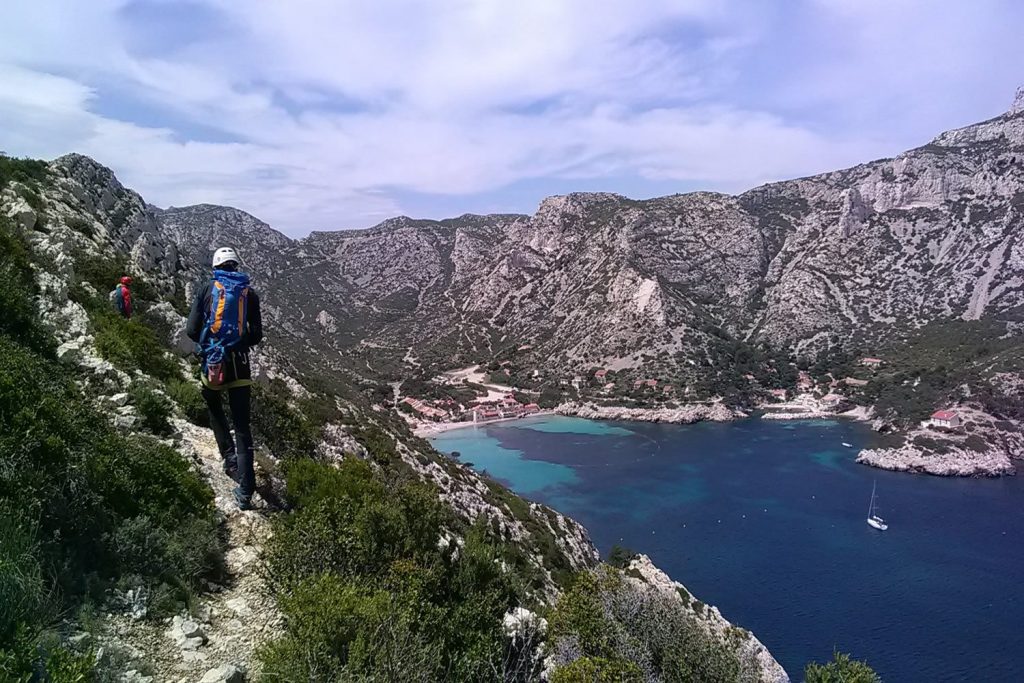
Canyoning demands that you master five physically distinct disciplines – abseiling, swimming, jumping, sliding, and bouldering – within the same two-hour window, in an environment that is actively trying to knock you off your feet. What is canyoning, precisely? It is a full-body, multidisciplinary descent of a water-carved gorge, and it is far more accessible than most people assume.
Adrenaline 06 brings over 25 years of operational experience and state-certified DEJEPS guides to the canyon systems of the Alpes-Maritimes. This article covers the core techniques, the geology that makes this region exceptional, the safety framework, who can participate, and exactly what to expect on your first descent.
What Is Canyoning? Defining the Sport and Its Core Elements
Canyoning is the multidisciplinary descent of a natural canyon environment using abseiling, swimming, jumping, sliding on natural toboggans, and bouldering over river rocks. It draws techniques from three parent disciplines: mountaineering, caving, and whitewater navigation, each with a distinct risk profile and physical skill set.
The Official Definition: More Than Just Getting Wet
The canyon itself is a dynamic, living system. Karst calcaire (calcium carbonate limestone) dissolves over millennia under slightly acidic meteoric water, producing deep, narrow gorges with sheer vertical walls. So the practise of canyoning combines aquatic and vertical elements that change acutely with every season, making local guide knowledge non-negotiable.
At least five biomechanically distinct movement disciplines are involved – abseiling, downclimbing, bridging and chimneying, aquatic swimming, and bouldering – each requiring a completely different physical approach. A participant who prepares only for swimming will encounter the frictional demands of wet limestone downclimbing before the aquatic sections even begin.
Canyoning vs. Canyoneering: Is There a Difference?
Canyoneering is the North American English term for the same discipline. Across Europe and France, canyoning is standard. Neither should be confused with aqua trekking (randonnée aquatique), a gentler, non-vertical variant involving walking and swimming through gorges without rope work.
Our guided excursions in the Alpes-Maritimes introduce every discipline progressively – building your experience around what you can do, not what you can’t.
The Core Techniques: What You Actually Do Inside a Canyon
Inside a canyon, you will use rope systems, your body weight, and the water itself to move from top to bottom. Each technique serves a specific purpose and carries its own physical demands.
Abseiling (Rappel): The Foundational Descent Technique
Abseiling is the foundational technique: using static canyoning ropes and friction devices to control descent speed down vertical or overhanging limestone faces, often directly through waterfalls. The biomechanical challenge is maintaining a perpendicular stance against moss-covered, lubricated rock while managing the physical force of a descending water column – categorically different from dry-rock abseiling.
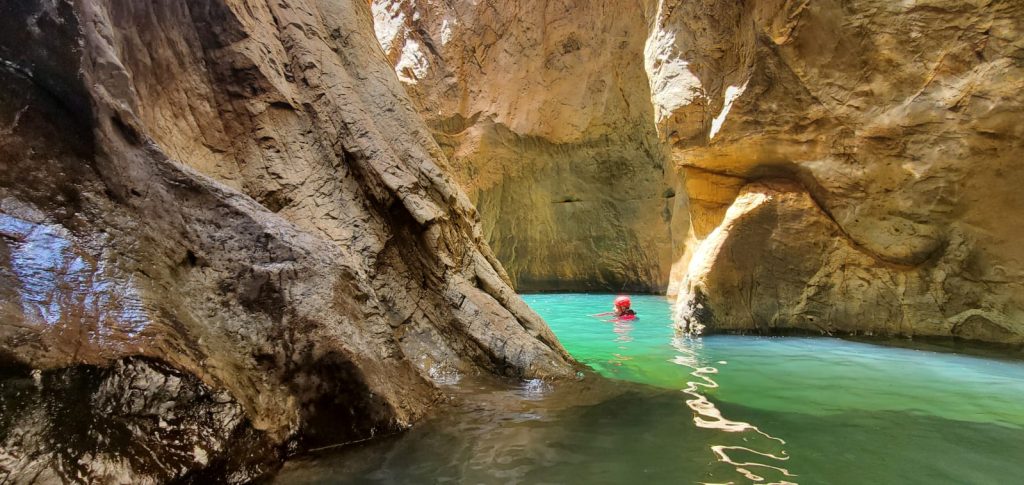
Bridging, chimneying, and stemming allow traversal of narrow gorge corridors where the floor is submerged. These techniques exploit the friction coefficient between neoprene suits, rubber-soled footwear, and limestone to cross above hydraulic hazards without swimming.
Downclimbing demands precise hand and foot placements on wet calcaire and continuous rock stability assessment.
Jumping, Sliding, and Swimming: The Aquatic Progression
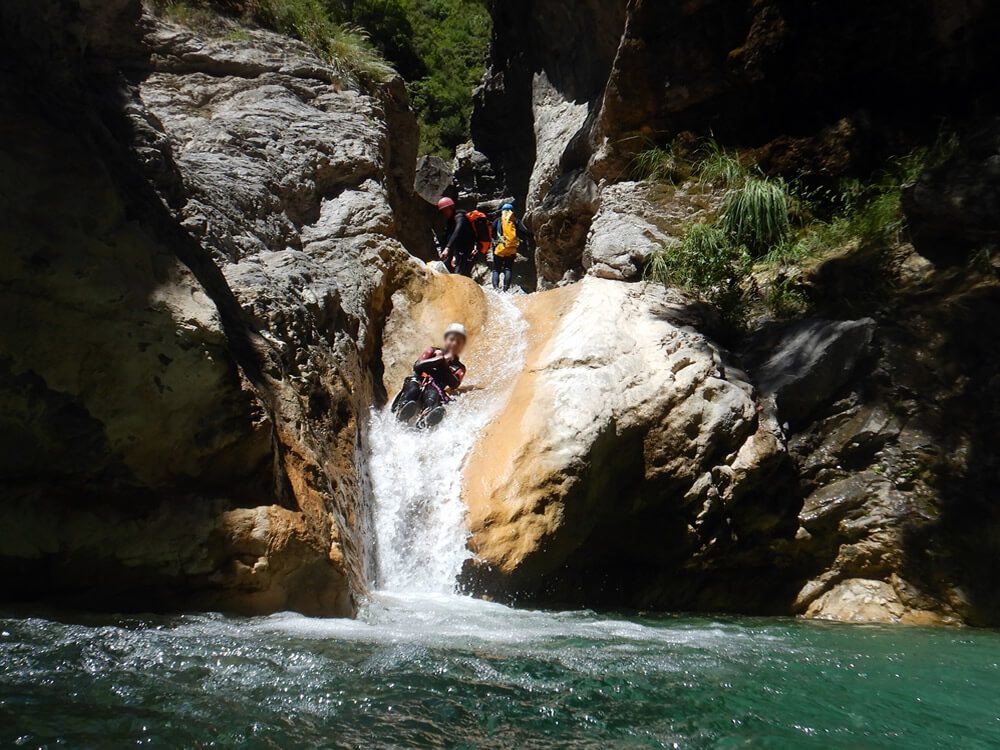
Toboggans naturels (natural rock flumes) allow rapid descent into plunge pools. Maintaining a rigid, streamlined body position prevents abrasive contact with bedrock. Jumping carries the highest situational risk: mandatory depth verification by the lead guide rules out submerged hazards, seasonal debris, or insufficient water volume before any participant leaves the rock.
A critical non-obvious hydrological risk is that clear skies above the gorge don’t indicate safe conditions. A rainstorm in the upper Mercantour Alps catchment can trigger a flash flood with zero warning.
Every participant on our guided excursions receives a full technique briefing before entering the canyon, and our guides always provide a safe bypass for any obstacle you don’t feel ready to attempt.
The Geology Behind the Adventure: Why the Alpes-Maritimes Is a World-Class Canyoning Destination
The Alpes-Maritimes is one of Europe’s most technically varied canyoning territories because of its karst limestone geology – a rock type that water carves into extraordinary shapes over millions of years.
Karst Limestone: The Rock That Builds Perfect Canyons
Slightly acidic meteoric water dissolves calcaire over millennia, creating deep narrow gorges, sheer vertical cliffs, and complex subterranean drainage systems. Vertical cliffs in the region frequently exceed 200 to 300 metres. The erosion process also forms marmites de géants – deep circular plunge pools carved by the rotational grinding of water and suspended sand – which serve as critical landing zones for jumps and abseils.
The history of canyoning of this region is inseparable from its geology: the same karst formations that drew 19th-century explorers continue to define the sport today.
From the Gorges du Loup to the Clue de Riolan: A Region of Extraordinary Variety
Canyon difficulty is not determined by the height of the biggest abseil. Logistical commitment – specifically the presence or absence of mid-route escape vectors – is the more consequential safety variable. The Clue de Riolan carries a minimum age of 16 years despite its 15-metre maximum abseil being lower than the Bès de Courmes’ mandatory 30-metre rappel, precisely because its 5-hour descent with zero emergency exits turns any injury into a full-scale rescue operation.
| Canyon | Max Abseil | Max Jump | Min Age | Descent |
| Gorges du Loup | Optional | 9 m | 8 yrs | 2-5 hrs |
| Bès de Courmes | 30 m (mandatory) | – | 14 yrs | 5 hrs |
| Clue de Riolan | 15 m | 10 m | 16 yrs | 5 hrs |
| Rio Barbaira | 12 m | – | 12 yrs | 2.5-4 hrs |
| Vallon de l’Imberguet | 20-25 m (mandatory) | 2-3 m | 12-14 yrs | 3.5-4 hrs |
We operate across all of these canyon systems and match every group to the route that fits their fitness, age, and appetite for adventure.
Is Canyoning Safe? Understanding Risk, Regulation, and Professional Standards
Zero risk doesn’t exist in any outdoor sport. Professional canyoning in France operates under one of the most stringent regulatory frameworks in the world – and understanding that framework is how you choose a legitimate operator.
The French Regulatory Framework: DEJEPS, BPJEPS, and State Certification
The DEJEPS (Diplôme d’État de la Jeunesse, de l’Éducation Populaire et du Sport) with the specific mention canyonisme is the gold standard state certification for commercial canyon guiding in France. This credential is not a permanent, lifetime qualification. DEJEPS canyonisme authorisation is legally valid for only 6 years.
At expiry, the guide must complete a mandatory stage de recyclage to legally renew their operational licence. An operator whose guide’s DEJEPS has lapsed is operating outside the law – their Professional Civil Liability (RCP) insurance is void, and in the event of participant injury, the operator faces severe criminal liability.
Arrêtés Préfectoraux issued by the Direction Départementale de la Cohésion Sociale des Alpes-Maritimes trigger emergency canyon closures during heavy rainfall or dangerously swollen torrents. Guides face criminal liability if operations proceed during a restricted period.
Safety Equipment: What Every Participant Must Wear
Mandatory equipment includes a 5mm neoprene one-piece wetsuit, neoprene socks, helmet, and harness – all provided by Adrenaline 06. Participants must wear closed-toe lace-up trainers, and no beach shoes or slip-on water shoes are permitted.
All participants must be able to swim and be comfortable fully submerging.
At Adrenaline 06, every guide holds a valid state diploma, carries RCP insurance, and brings over 25 years of rescue and field experience – including Philippe Auvaro, founder of the National Canyon Rescue School (ECASC), and Jean-François (Jeff), lead trainer at the same institution.
Who Is Canyoning For? Accessibility, Age, and Group Types
Canyoning is not exclusively for extreme athletes or young adults. The 51-60 age group accounts for 25.7% of the global adventure tourism market. Soft adventure tourism commands 65.1% of total industry revenue.
Families, Beginners, and First-Timers: The Gorges du Loup Discovery
The Gorges du Loup Discovery is the ideal entry point. Minimum age is 8 years, jumps from 1 to 9 metres are optional, bypasses are abundant, and the canyon sits 45 minutes from Nice. Children under 14 must be accompanied by an adult.
The Bès de Courmes raises the minimum age to 14 years – the mandatory 30-metre abseil alongside the 60-metre Cascade de Courmes introduces genuine psychological and technical challenge. The Clue de Riolan is for physically fit, experienced participants aged 16 and over who want a full 5-hour sporting commitment.
Groups, Corporate Teams, and Special Occasions
Stag and hen parties (EVG/EVJF) benefit from specialised packages built around fun, adrenaline, and group cohesion. Small-group adventure formats are up to 35% more effective at forging genuine interpersonal connections than large-scale generic events.
Gift vouchers are available for birthdays and special occasions. Our VIP Guide Privatisation option delivers a completely personalised canyon tour adapted exclusively to your group’s pace and preferences.
Canyoning and the Environment: Protecting the Natural Playground
The canyons of the Alpes-Maritimes are legally protected ecosystems that need active stewardship from every operator and participant.
Natura 2000 and the Gorges du Loup: A Protected Ecosystem
The Gorges du Loup and Rivière du Loup are classified as Natura 2000 network sites – the European ecological protection framework enforced via the 1979 Birds Directive and the 1992 Habitats, Fauna, and Flora Directive. Any commercial operation in a Natura 2000 site that may inflict a detrimental impact on protected species must undergo a rigorous prior biodiversity assessment.
Arrêté préfectoral n°2016-852 (Vallon de l’Imberguet) needs participants to stay strictly out of the stream bed for the first 300 metres to protect Austropotamobius pallipes (white-clawed crayfish) and Salmo trutta fario (brown trout) spawning habitats.
Endemic Species and Why Your Footprint Matters
Chemical disinfection of shared neoprene equipment poses a severe ecological threat. Even highly diluted concentrations of active pathogenic disinfectants in post-wash rinse water cause severe harm to microorganisms. Petroleum-based surfactants dramatically increase eutrophication potential, leading to oxygen depletion and the death of endemic fish and crustacean populations.
Austropotamobius pallipes populations have plummeted by 80% since 1960 due to crayfish plague and habitat fragmentation.
An operator using a chlorine-based wetsuit wash and disposing of rinse water into a drain connected to the Loup river system is in direct violation of environmental directives. Booking with a non-compliant operator risks contributing to a protected species violation – and in a Natura 2000 site, that carries regulatory consequences for the commercial operation you are funding.
Adrenaline 06 provides 100% biodegradable, plant-derived surfactant washes – alcohol-free, chlorine-free, non-toxic – for all neoprene gear cleaning after every descent. This is not a marketing claim: it is the specific equipment provision we make to keep every canyon we operate in legally open and ecologically intact.
What to Expect on Your First Canyoning Tour: A Practical Overview
Your first canyoning tour runs from briefing to exit in a single, well-structured day.
What to Bring, What to Wear, and What We Provide
All mandatory safety equipment is provided through our Complete Equipment Provision: 5mm neoprene one-piece wetsuit, neoprene socks, helmet, and harness. What you must bring: closed-toe lace-up trainers. No beach shoes.
No slip-on water shoes. This is a non-negotiable safety requirement. Waterproof cameras and GoPros must be securely attached with a leash. Payment is accepted by cash, Paylib, or bank transfer only – no credit cards. The maximum waiting time for latecomers is 30 minutes, after which the booking is forfeited without refund.
Seasonal Conditions and the Best Time to Go
Canyon river water in the Alpes-Maritimes rarely exceeds 15-16°C even in peak August, when the Mediterranean Sea surface reaches 23-24°C. Water temperature within deep gorge environments remains static regardless of time of day – continuous high-altitude water flow and the absence of direct solar radiation prevent any thermal gain. A participant entering in a 3mm surf wetsuit faces rapid onset hypothermia within 45-60 minutes.
June and September offer optimal flow conditions and predictable hydrology. April and May see extremely high flow from Mercantour snowmelt – many routes are restricted. October brings variable conditions and flash flood risk. Staggered departure times of 9:00 AM, 1:00 PM, and 4:30 PM avoid peak congestion and maintain safe daylight margins. The Gorges du Loup is 45 minutes from Nice and 15 minutes from La Colle-sur-Loup – a full adventure day fits entirely within a coastal holiday base.
Check the seasonal conditions above and identify which month and canyon route best matches your group’s fitness level and availability. Browse our canyon descents – from the family-friendly Gorges du Loup Discovery to the advanced Clue de Riolan – and book your guided excursion directly on the Adrenaline 06 website.
Frequently Asked Questions
What is canyoning in France?
Canyoning is the guided descent of natural canyon gorges using abseiling, swimming, jumping, and sliding. French law needs commercial guides to hold a state-certified DEJEPS canyonisme diploma. The Gorges du Loup, near Nice, is the iconic entry-level route in the Alpes-Maritimes.
What do you do in canyoning?
You abseil down waterfalls, swim through plunge pools, jump from rock platforms, slide down toboggans, and boulder over river rocks. No obstacle is compulsory – guides always provide bypass alternatives. All equipment is provided. Canyoning is not rafting: there is no boat. The descent is on foot, rope, and in the water.
Is canyoning an extreme sport?
Canyoning exists on a wide spectrum. The Clue de Riolan – 5-hour descent, zero escape vectors, minimum age 16 – is genuinely extreme. The Gorges du Loup – minimum age 8, optional jumps, abundant bypasses – sits firmly in soft adventure territory. This commands 65.1% of the global adventure tourism market.
What exactly is canyoning?
Canyoning (canyoneering in North America) is the multidisciplinary sport of descending a canyon combining mountaineering rope work, caving navigation, and whitewater swimming. It differs from via ferrata, rock climbing, and rafting. The canyon – carved through karst limestone – is both the route and the obstacle.
How fit do you need to be to go canyoning?
Entry-level routes like the Gorges du Loup need no prior technical training and are suitable from age 8. The primary prerequisite is the ability to swim and submerge comfortably. The Clue de Riolan demands sustained cardiovascular endurance for a 5-hour descent with zero escape vectors.
What is the difference between canyoning and via ferrata?
Via ferrata uses permanently installed iron rungs, cables, and ladders – mainly vertical and dry. Canyoning descends a water-carved gorge combining rope work, swimming, jumping, and sliding – aquatic, dynamic, and multi-directional. Both are available through Adrenaline 06 in the Alpes-Maritimes.