

49% of all documented canyoning accidents worldwide occur during rope progression phases alone. That number doesn’t mean canyoning is reckless. It means the difference between a safe descent and a dangerous one is almost entirely determined by who is standing next to you on that rope.
At Adrenaline 06, our guides include the founder of the National Canyon Rescue School, a UIAGM High Mountain Guide, and professional firefighter-rescuers with over 35 years of canyon experience each. This article covers our team credentials, the real risks behind the statistics, how we manage them in practice, and which descents suit which participants.
Who We Are: The Rescue Credentials Behind Every Descent We Lead
Our guides don’t just know these canyons – they’ve extracted casualties from them.
A Team Built From the Rescue Services, Not Just the Canyon
Philippe Auvaro has led canyon descents for 35+ years, serves as a professional Fire Officer and mountain rescuer, founded the National Canyon Rescue School, and acts as Pedagogical Manager at ECASC (Civil Security Application School). Jean-François (Jeff) mirrors that profile: 35+ years as a canyon guide, State Diploma DEJEPS in Canyonism, professional Firefighter Officer, and co-author of canyoning guidebooks for Sardinia, Corsica, and the Alpes-Maritimes. But Damien Paltrinieri brings 15+ years as a professional firefighter-rescuer and specialises in risk analysis.
Certifications That French Law Requires – And We Exceed
Thomas Auvaro holds UIAGM (International Federation of Mountain Guides Associations) High Mountain Guide certification – the apex global standard – with expeditions across the Himalayas, Patagonia, Greenland, Alaska, and Yosemite. French state rescue certification assessments need flawless rescuer-to-swimmer extraction in moving water; any inefficient action results in automatic prohibitive failure.
Operating commercially without DEJEPS or BEES qualifications and active RCP (Professional Civil Liability) insurance is a criminal offence. Every Guided Canyoning Tour we operate is led exclusively by guides who have passed that standard.
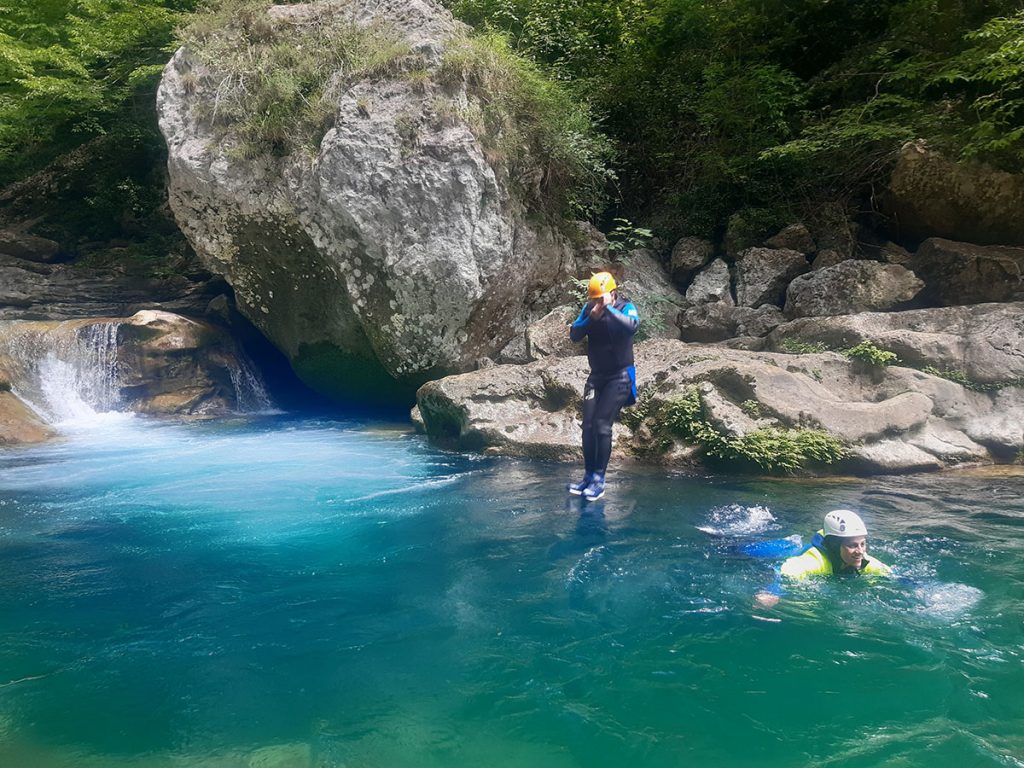
So, Is Canyoning Dangerous? The Honest Answer
Canyoning carries real, quantifiable risk. It also carries a safety architecture that transforms that risk profile entirely when professionals are in charge.
What the Global Accident Statistics Actually Tell Us
49% of all documented canyoning accidents occur during rope progression phases. 22% occur during aquatic walking – the most mundane-seeming phase of any descent. Biofilm-coated karstic limestone is effectively frictionless when wet – a surface that looks like a shallow stream crossing produces the same slip dynamics as black ice.
Lower limb trauma dominates injury typology: 25% of incidents produce tibia/fibula fractures, and 24% produce severe ankle injuries, mainly caused by slipping on biofilm-coated karstic bedrock or incorrect water entry angles.
The Lessons History Has Forced the Industry to Learn
The Saxeten Canyon disaster (Switzerland, 1999) killed commercial groups regardless of skill level – a localised upstream thunderstorm generated a debris-filled tidal wave inside a narrow gorge, with clear skies at canyon level. The Zoicu Canyon tragedy (Corsica, 2018) killed five people including the guide, who proceeded despite explicit peer warnings from professionals who had already aborted.
Karstic hydrology is the mechanism: limestone gorges have porous structures and subterranean drainage networks, meaning a storm 20 kilometres upstream generates a wave with no visible warning at canyon level.
Our Guided Canyoning Tours include mandatory pre-descent Météo-France alert checks – an Orange or Red vigilance alert for our sector means we don’t enter the canyon.
What Are the Specific Dangers of Canyoning?
Understanding the potential dangers of canyoning means understanding where accidents actually concentrate – not where they feel most dramatic.
Rope Progression: Where 49% of Accidents Happen
Abseiling needs precise anchor management and speed control on a static rope. Staying alive on a static rope needs total body discipline: panic causes participants to release the brake rope or lock knees rigid, producing violent pendulum swings into the rock face and pelvic or cranial trauma.
Natural toboggans demand arms crossed tightly and chin tucked – incorrect posture frequently results in cervical spine trauma. The Vallon de Bès-Courmes illustrates why technique is non-negotiable: six sequential abseils of 10-15 metres culminating in a mandatory 30-metre terminal abseil.
Aquatic Hazards: Siphons, False Floors, and Plunge Pools
Siphons – submerged tunnels formed by rock collapse – present immediate drowning hazards if current strength is misjudged. False floors (*planchers faux*) form when boulders accumulate over subterranean water flow, then collapse without warning, creating lethal crush hazards.
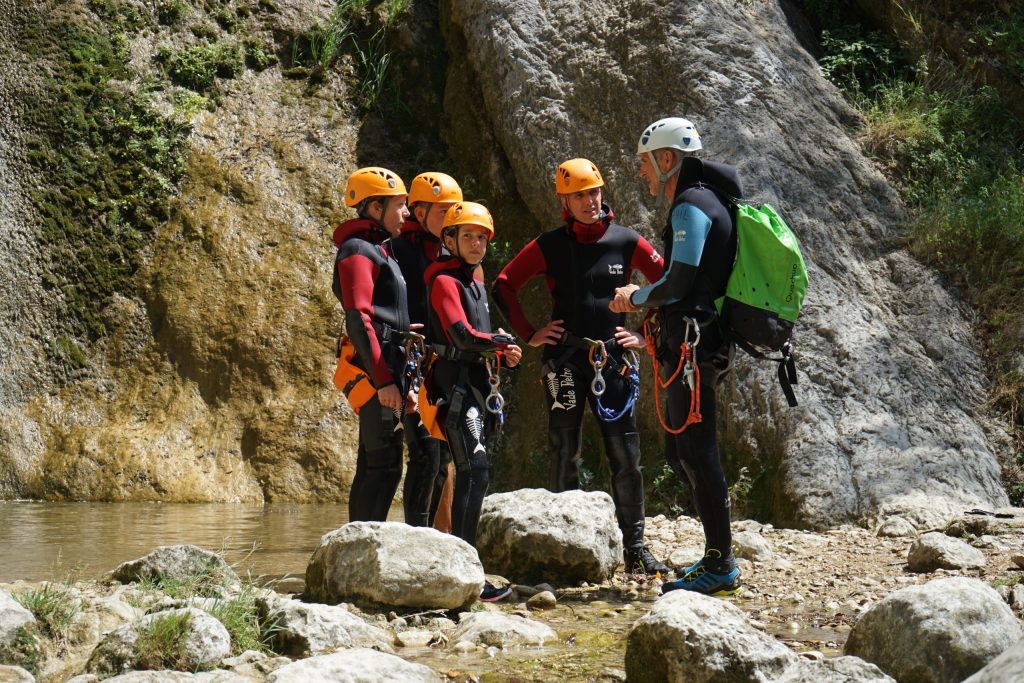
Plunge pools mask submerged rock shelves beneath aerated or murky water – incorrect jump entry angle causes severe spinal compression. Our Safety Equipment Provision – helmets, harnesses, and 5mm neoprene wetsuits – directly addresses the mechanical failure points behind these injury typologies.
How We Manage Risk: Our Safety Protocols in Practice
Risk management in canyoning is not a checklist. It’s a set of rules that are never negotiated, regardless of commercial pressure.
Equipment, Meteorology, and the Rules That Are Never Negotiable
A Météo-France Orange or Red vigilance alert constitutes a direct stop-work order – ignoring it invalidates all professional liability insurance and is a criminal violation. Prefectural law (*Arrêté préfectoral*) caps commercial groups at a maximum of 10 individuals, including the guide; hyper-sensitive routes are restricted to 6 participants. Daily canyon access is strictly illegal before 09:00 and after 17:00.
Karstic gorge water averages 15°C during peak summer: continuous immersion without 5mm neoprene rapidly induces hypothermia and muscular cramping. Closed-toe lace-up trainers are mandatory. No beach shoes or water sandals are permitted on any descent.
The ‘Nothing Is Mandatory’ Principle – And Why the Guide Has the Final Say
No jump, slide, or abseil is ever compulsory, and our guides provide a bypass route for every obstacle. Hesitation mid-leap – pausing after committing to a jump – is a documented cause of horizontal water entry and spinal compression.
The bypass route eliminates that injury mechanism entirely. A guide who pressures a hesitant participant to jump rather than offering the bypass directly increases the probability of the injury the bypass was designed to prevent. Our Safety Equipment Provision and Guided Canyoning Tours operate as one integrated system – equipment is sized by the same rescue professionals who lead the descent.
Canyoning in the Alpes-Maritimes: The Gorges We Know Better Than Anyone
From Initiation Routes to Technical Canyons: Matching the Descent to the Participant
The canyoning descents we lead in the Alpes-Maritimes range from family-friendly introductions to serious technical routes. The Gorges du Loup is our benchmark initiation route: minimum age 11, 2 hours in-water, maximum optional jump 9 metres, €60 per participant. The Clue de Riolan (Estéron Valley) is a different proposition: vertical walls exceeding 300 metres, 3.5 km linear length, 4.5-6 hours aquatic progression, minimum age 16, €75 – with zero lateral escape routes.
The Rio Barbaira (Rocchetta Nervina, Liguria) offers 8 consecutive rappels up to 20 metres, 3-4 hours in-canyon, minimum age 14, €85. The Vallon de l’Imberguet (Vésubie Valley) operates May-June only due to summer desiccation – a hydrological fact consumer apps don’t flag.
Why Local Knowledge Is a Safety Asset, Not a Marketing Claim
The Clue de Riolan’s zero lateral escape routes mean a participant exhausted at hour four of a six-hour progression has no option but to continue forward, and physical fatigue near rappel anchors is precisely when the 49% rope-phase accident rate becomes most relevant. Our guides know which upstream catchment areas generate flash flood risk for each specific route.
These bedrock sections carry the heaviest biofilm in spring, and which plunge pools have submerged shelves at specific water levels. Our VIP & Private Canyoning option provides dedicated supervision with a pre-descent briefing tailored to the specific hydrological profile of the chosen canyon.
How Do We Protect the Gorges We Descend?
Natura 2000 Rules, Endemic Species, and Why We Brief Every Group Before Entry
Canyons in the Alpes-Maritimes are Natura 2000 protected zones – biological corridors where deviating from predefined ecological paths causes immediate mechanical destruction of endemic Saxifraga species anchored in riparian limestone fissures. Biotope Protection Decrees (*Arrêté de Protection de Biotope – APB*) ban human penetration into designated cliff faces.
Our guides know every protected cliff face by name – because protecting them is part of what makes these gorges worth descending.
Every Guided Canyoning Tour around Nice includes the mandatory pre-entry ecological briefing as a standard component of every descent we lead, not an optional add-on. Austropotamobius pallipes (White-Clawed Crayfish) is subject to rolling 5-year total bans on human interaction, enforced by the OFB (French Office of Biodiversity).
At the Imberguet approach, participants must stay out of the stream bed for the first 300 metres – we brief every group on this before the approach walk.
Ecocarex Xcare and Zero-Trace Operations
We use Ecocarex Xcare – a 100% biodegradable, ocean-friendly probiotic solution – exclusively to disinfect neoprene. It neutralises bacteria via natural enzymes without depositing toxic chemical residues into the watershed. Standard neoprene disinfectants present a lethal threat to amphibians including the French cave salamander and fire salamander, whose highly permeable skin absorbs toxins directly from the water column.
An operator using non-biodegradable cleaners in a Natura 2000 watershed faces OFB prosecution entirely separate from any participant safety incident. Our VIP & Private Canyoning option includes a dedicated environmental briefing that goes deeper into the specific ecology of your chosen gorge.
Can Beginners Go Canyoneering? Who Our Descents Are Designed For
Age, Fitness, and the One Ability That Is Non-Negotiable
Yes – beginners who want to discover canyoning for the first time will find our initiation routes are built precisely for that purpose, with one strict prerequisite: you must be comfortable with full water immersion. Olympic swimming ability isn’t required. Comfort with total immersion is.
Medical exclusions apply: pregnant women and individuals with severe cardiac or respiratory difficulties can’t participate. No alcohol or drugs before or during any descent. Children under 14 must be accompanied by an adult. Older unaccompanied minors need written parental authorisation.
From First-Timers to Families: Canyoning at Your Own Pace
No prior experience is required for initiation routes. The 51-60 age demographic now accounts for 25.7% of the adventure tourism market – our routes and teaching approach accommodate a wide range of fitness levels. The most common footwear error among first-timers is arriving in beach shoes or water sandals: zero lateral ankle support on polished limestone directly produces the 24% ankle fracture rate documented in global canyoning data, an injury requiring full helicopter extraction from a canyon with no road access.
Our VIP & Private Canyoning option provides dedicated supervision and fully personalised pacing for participants who want the highest-safety format we offer.
Browse our canyon routes – from the family-friendly Gorges du Loup to the technical Clue de Riolan – and use the age, fitness, and experience criteria listed in Section 7 above to match yourself to the right descent before you book. Then secure your place on a Guided Canyoning Tour with Adrenaline 06 directly on our website.
Frequently Asked Questions
What are the risks of canyoning?
The three primary risk categories are rope progression (49% of global accidents), aquatic walking (22% of incidents), and hydrological flash flooding – as demonstrated by Saxeten 1999 and Zoicu 2018. All are manageable with qualified guides and mandatory Météo-France monitoring before every descent.
What are the most common canyoneering accidents?
25% of incidents produce tibia/fibula fractures and 24% produce severe ankle injuries – both mainly from slipping on polished limestone or incorrect water entry on jumps. Rope-phase accidents account for the largest single category at 49% of all documented incidents worldwide.
How safe is canyoneering?
Zero risk doesn’t exist, but the safety architecture transforms the risk profile. DEJEPS/BEES-certified guides, prefectural group limits of 10 participants, mandatory Météo-France checks, and the ‘Nothing is Mandatory’ bypass protocol are the pillars of how we operate. Guided commercial canyoning carries high perceived risk and statistically low actual physical risk when professionally managed.
Can beginners go canyoneering?
Yes. Swimming comfort (full immersion) is the one non-negotiable requirement. Canyoning in the Gorges du Loup – minimum age 11, 2 hours in-water, €60 – is our benchmark initiation route. No prior experience is needed. Children under 14 must be accompanied by an adult. Every obstacle has a bypass route – nothing is compulsory.