
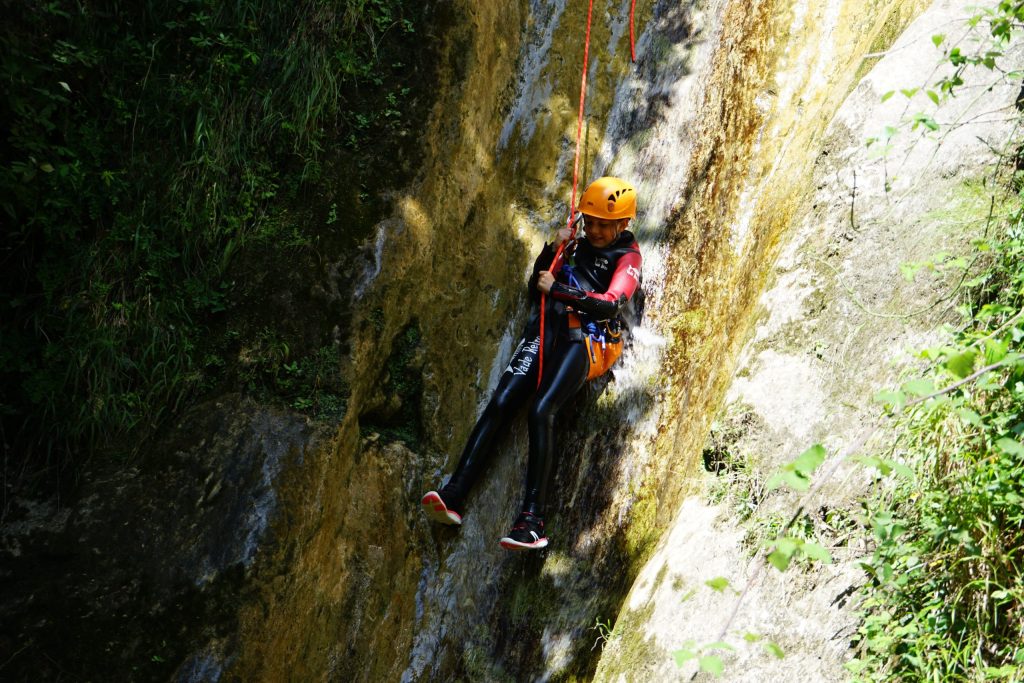
Abseiling in canyoning is not the same discipline as abseiling on a dry rock face. The moment a static rope meets rushing water, algae-covered limestone, and a 65-metre free-hanging drop above a turquoise pool, every assumption borrowed from dry-land rappelling must be rebuilt from scratch.
At Adrenaline 06, our team holds 25+ years of professional canyoning and mountain rescue experience across the Alpes-Maritimes. This article covers the mechanics of rappelling, the gear required, the descent sequence, our flagship routes, safety protocols, environmental responsibilities, and the qualifications behind every guided descent.
What Exactly Is Abseiling in Canyoning – and How Does It Differ from Standard Rappelling?
Abseiling, also called rappelling, is a controlled descent that modulates friction on a fixed static rope. In canyoning, it functions as a technical access tool to unlock sections of canyon that are otherwise impassable: waterfalls, vertical gorge walls, confined meanders.
The Core Definition: Controlled Descent on a Static Rope
Canyoning operates at the intersection of hydrology, geology, and vertical rope access. Static or low-stretch cordage is exclusively mandated because the elastic elongation built into dynamic climbing ropes causes the rope to bounce and saw against sharp limestone edges under sustained load.
This can abrade through the sheath, creating a catastrophic mid-descent failure risk invisible to the descender until the core is already compromised – a mid-pitch rope failure above a 30-metre free-hanging drop with no lateral egress and no second rope in the system, a non-survivable fall in a confined gorge.
Why Canyoning Rappelling Demands a Completely Different Skill Set
The Dülfersitz technique – wrapping the rope across the hip and shoulder – is archaic and largely obsolete, serving only as a historical baseline for modern mechanical descender evolution. Our state-certified guides teach correct abseiling techniques from the first step, covering the aquatic variables that a climbing course doesn’t address.
The Essential Gear for Abseiling in Canyoning: Ropes, Descenders & Harnesses
A dedicated canyoning rope is engineered specifically for abrasion resistance against wet limestone. It’s not interchangeable with a climbing rope.
Choosing the Right Canyoning Rope: Abrasion Resistance and Rope Length
Rope length selection follows one rule: the rope must be at least twice the height of the longest pitch plus a retrieval margin. A 30-metre abseil needs a minimum 65-metre rope. A specialised canyoning rope engineered for wet limestone carries a fundamentally different construction to any climbing rope, with a tightly braided sheath designed to resist the continuous abrasion of water-polished rock edges.
The Figure-of-Eight Descender, the Baudrier, and the Auto-Locking System
The Figure-of-Eight Descender controls descent velocity by forcing the rope through its apertures to generate thermal and mechanical friction, but it introduces torsional twists and carries a real risk of being dropped in wet, gloved hands. The Baudrier – a canyoning harness fitted with PVC abrasion protectors – differs structurally from standard climbing harnesses.
So novices frequently clip lanyards into the belay loop rather than hard tie-in points, shifting the centre of gravity and creating inversion risk under hydraulic shock loads.
The Système autobloquant (auto-locking system) acts as a backup, and Main frein (braking hand) discipline – never releasing the rope – is non-negotiable. Through our Fourniture de matériel homologué service, we provision every participant with certified, biometrically sized gear.
How Does a Canyoning Abseil Actually Work? The Step-by-Step Descent Sequence
A canyoning abseil runs from anchor inspection through rope threading, harness check, edge approach, controlled descent, pool arrival, and mechanical disconnect. Each stage carries a specific failure mode.
Anchor Systems: From Natural Amarrages to Fixed Bolts
Amarrage naturel ou foré describes the difference between a chockstone used as a natural anchor and stainless steel expansion bolts permanently installed in bedrock. Both need physical inspection before weighting.
The Fireman’s Belay, Assurage Mutuel, and the Figure-8 Contingency Block
The Figure 8 Contingency Block locks the descender onto the anchor-side of the rope, allowing the top guide to instantly convert the static line into a dynamic lowering system if a participant becomes trapped. Catastrophic failure occurs if the participant weights the bag side rather than the anchor side – entirely preventable by a three-second pull-test before committing to the edge. The Fireman’s Belay – a team member at the base pulling downward on the active rope – instantly arrests a rappeller who has lost control.
Assurage mutuel (mutual belaying) is the team-based safety culture that holds all of this together. Our Encadrement professionnel guides supervise every stage, from anchor inspection to pool-side disconnect.
Spider Abseiling and the 65-Metre Rappel: What Awaits at Bès de Courmes
The Bès de Courmes descent initiates at 623 metres above sea level and terminates at Pont du Loup, representing an aggregate vertical drop of 445 metres across six distinct abseils.
Free-Hanging Descents: The Spider Abseil (Fil d’Araignée) Explained
Spider Abseiling (Fil d’Araignée) is a free-hanging vertical descent conducted entirely suspended in mid-air, away from contact with the rock face. On a free-hanging descent, the critical failure point is not the step off the edge – it’s the pool arrival. Failure to disconnect from the descender before the rope goes slack risks being pulled backwards into the hydraulic boil at the base of the waterfall, requiring immediate guide intervention.
Rope Length, Vertical Drop, and the Full Topography of Bès de Courmes
The six abseils at Bès de Courmes range from 10 to 15 metres, culminating in the 30-to-65-metre final spider abseil depending on the rigging point used. A 65-metre pitch needs a minimum 130-metre rope for retrieval. The Clue du Riolan features limestone walls rising to 200-300 metres with zero lateral emergency egress during the core descent.
The Gorges du Loup beginner route offers a maximum 10-metre abseil over 2.5 hours for comparison. Book your descent at Bès de Courmes directly through Adrenaline 06.
Safety in Canyoning Abseils: Managing Real Risks Without Eliminating the Adventure
The Risks Linked to Rappel: What the Data Actually Shows
Acoustic clutter at belay stations is a direct causal factor in accidents. Loud non-essential conversation masks critical safety commands – “Off rope,” “Slack,” “Rock” – between the descending canyoneer and the top guide, causing premature rope deployment or failure to execute a Fireman’s Belay at pool arrival. Silence discipline at belay stations is non-negotiable.
Equipment Checks, Footwear Rules, and the Non-Negotiables Before You Descend
Soft-soled aquashoes and beach sandals lack rigid torsional shanks, directly causing violent slips, ankle sprains, and impact fractures on wet limestone. Adrenaline 06 bans beach shoes and offers specialised canyoning shoe rentals at €10 – available to every participant at the time of booking as part of our standard equipment provision. Article 7 of the Prefectural Order legally binds operators to verify every participant’s swimming ability and comfort with total head immersion before route ingress.
The legal maximum of 8 participants per guide is the state safety doctrine. Aquatic canyoning is restricted to 1 April – 31 October in the Alpes-Maritimes. Our guides always provide a bypass, but reserve the right to refuse access to any obstacle if safety is compromised.
Abseiling in Canyoning and the Environment: Protecting the Alpes-Maritimes Canyons
Canyoning routes in the Alpes-Maritimes intersect directly with Natura 2000 protected areas framework Special Areas of Conservation, governed by Article 6 of the EU Habitats Directive.
Natura 2000, Karst Ecosystems, and Why Your Rope Matters to a Crayfish
Austropotamobius pallipes (White-Clawed Crayfish) – the only crayfish native to the region – hides among submerged rocks at around one metre depth and is critically sensitive to habitat degradation. Aphanomyces astaci (Crayfish Plague) is a lethal oomycete pathogen that survives on damp neoprene wetsuits after a freshwater rinse.
A single contaminated wetsuit transported between hydrological basins can cause total local extinction – an irreversible outcome. The Préalpes d’Azur Regional Natural Park covers 92,000 hectares and sustains the entire French Riviera coastline via karst aquifers fed by these canyons.
Our Environmental Commitment: Zero-Impact Sanitation and Biodegradable Protocols
We wash all neoprene suits and harnesses with 100% biodegradable disinfectants after every descent. At the Canyon de l’Imberguet, participants must stay out of the stream bed for the first 300 metres to protect the endemic crustacean population – a non-negotiable rule enforced by our guides.
Why Professional Guiding Makes the Difference: The Adrenaline 06 Team
The DEJEPS qualification – the French state’s legal minimum for commercial canyoning guiding – needs extensive practical assessment in swift-water rescue, advanced rigging, and group psychology. It’s the floor, not the ceiling.
UIAGM, DEJEPS, and 35 Years of Canyon Rescue Experience
Philippe Auvaro holds 35+ years of experience as a Canyon Guide, professional Fire Officer, mountain rescuer, and founder of the National Canyon Rescue School, where he serves as Pedagogical Manager at ECASC. Jean-François (Jeff) holds a DEJEPS specialising in Canyonism, 35+ years of experience, and co-authored canyoning guidebooks for Sardinia, Corsica, and the Alpes-Maritimes.
Thomas Auvaro holds the UIAGM High Mountain Guide certification, which, under French law, automatically authorises canyon descents, with expeditions across the Himalayas, Patagonia, and Yosemite. Damien Paltrinieri brings 15+ years of experience as a professional firefighter and rescuer with expertise in risk analysis. In a genuine emergency, the gap between a DEJEPS-minimum operator and a team that includes UIAGM guides and National Canyon Rescue School founders is a measurable difference in emergency response capability.
VIP and Private Guiding: Personalised Instruction for Every Level
Our Privatisation du guide (VIP Guide) service provides one-to-one instruction, private pacing, and exclusive access, designed for participants overcoming fears of verticality at their own pace. Every guide holds valid professional cards, state diplomas, and Professional Civil Liability insurance.
Check the current seasonal access calendar for the Alpes-Maritimes (1 April – 31 October) and confirm your group size is within the legal 8-participant maximum before booking.
Frequently Asked Questions
What makes canyoning abseiling different from regular rappelling?
Canyoning abseiling uses a dedicated static rope for abrasion resistance on wet limestone – dynamic climbing ropes are prohibited. It needs a rapid mechanical disconnect at pool entry, a Fireman’s Belay from the base, and functions as a technical access tool rather than a standalone activity.
What equipment do you need for canyoning?
Mandatory gear includes a 5mm neoprene wetsuit, canyoning harness with PVC abrasion protectors, Figure-of-Eight Descender, certified helmet, static canyoning rope, neoprene socks, and closed-toe lace-up trainers. Adrenaline 06 provides all certified gear, and specialised canyoning shoe rental is available at €10.
How difficult is canyoning?
The Gorges du Loup (Easy, 10m max abseil, 2.5 hours) suits beginners from age 8 and 25kg. Bès de Courmes (Expert Level 3, 65m spider abseil, 4.5-5 hours, 445m aggregate drop) demands advanced fitness. The Clue du Riolan needs a minimum age of 16. Every obstacle has a bypass.
How do you jump safely in canyoning?
Never jump without prior depth verification and visual inspection for submerged debris. Seasonal water level fluctuations can obscure newly deposited chockstones. The guide has the final say – participants are never forced to jump, but guides can also refuse a jump if conditions are unsafe.
What rope length do I need for canyoning abseils?
The rope must be at least twice the pitch height plus a retrieval margin. A 30-metre abseil needs a minimum 65-metre rope. The 65-metre Bès de Courmes spider abseil needs a minimum 130-metre rope. Dedicated canyoning ropes are specified for abrasion resistance on wet limestone and are not interchangeable with climbing ropes.
Is abseiling in canyoning safe for beginners and families?
Yes, with the right route and professional guidance. The Gorges du Loup is accessible from age 8 (minimum 25kg) with a 10-metre maximum abseil. All obstacles are optional. Guides hold DEJEPS and UIAGM qualifications with 25+ years of rescue experience. Pregnant women and those with severe cardiac or respiratory conditions can’t participate.
What are the best fall canyoning conditions in the Alpes-Maritimes?
Autumn or fall canyoning conditions in the Alpes-Maritimes typically run through October, the final month of the legal season (1 April – 31 October). Water levels stabilise after summer, temperatures remain manageable, and canyon crowds thin considerably. Confirm current access status before booking, as early autumn rainfall can temporarily close specific routes.
Browse our canyon routes – from the beginner rappels of the Gorges du Loup to the 65-metre spider abseil at Bès de Courmes – and book your guided descent directly on the Adrenaline 06 website. Payment by cash, Paylib, or bank transfer. Groups are capped at 8 for your safety.