
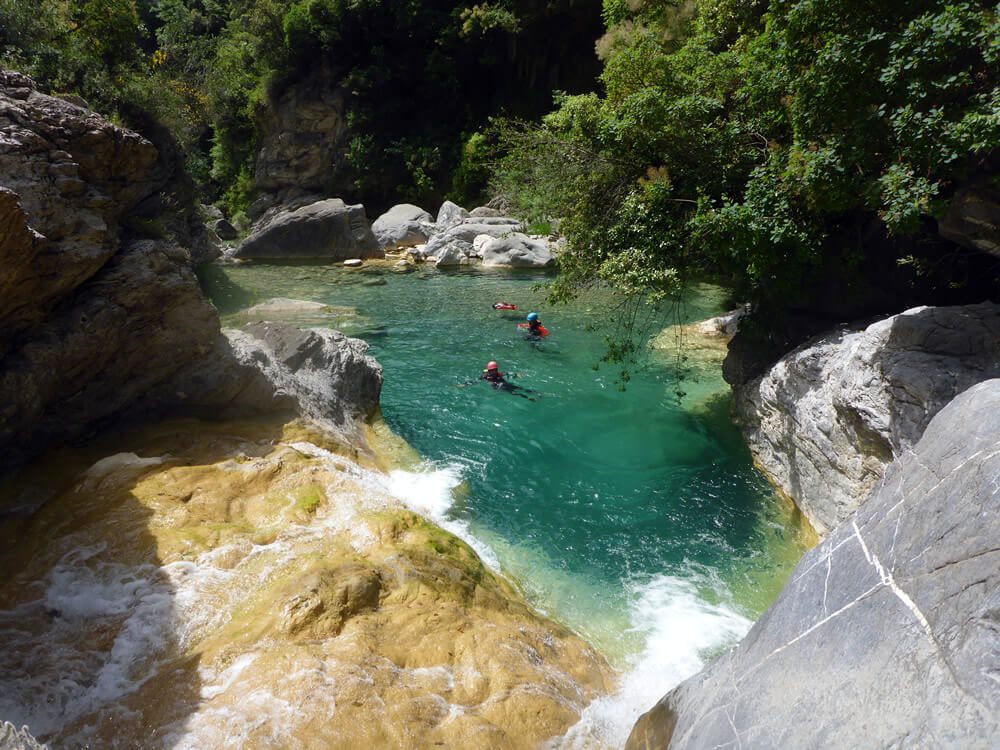
The Gorges du Loup is distinctive because the river has cut through uplifted Jurassic and Cretaceous limestone, creating a karst gorge with clear water, polished walls, jumps, abseils, natural rock slides and deep sculpted pools. The geology shapes the outing directly.
At Adrenaline 06, we guide this descent from our base near Gourdon as a specialist in canyoning in the Alpes-Maritimes for over 25 years. This guide explains the rock, water, regulations, guide credentials and decision points that matter before you book.
Why This Gorge Feels Different From The Riviera Coast
The gorge sits close to Nice, Cannes and Antibes, yet it feels like a separate mountain world because the river enters the limestone hinterland of the Alpes-Maritimes rather than the urban coast.
The contrast is part of the appeal. You can leave the French Riviera, reach Gourdon and find yourself in a cooler, enclosed route shaped by water, faults and limestone bedrock.
This is why short social posts and booking pages often miss the point. They show the activity, but they don’t explain why the setting works so well for a guided descent.
A Quick Orientation
Located a short distance from the coastal cities of Nice, Cannes and Antibes, the gorge serves as a strong contrast to the urbanised French Riviera. It is still accessible, but it feels preserved.
The site is used by walkers, swimmers, families and canyoning groups, so local management matters. That pressure makes the geology more than a scenic detail, because it affects access, water flow and the way we guide the route.
How Limestone Karst Created The Natural Site
The bedrock of the Alpes-Maritimes hinterland is mainly thick marine limestone, deposited during the Jurassic and Cretaceous periods when this region lay beneath a warm, shallow sea. Later Alpine uplift raised those sediments into the ridges and plateaus of the French Pre-Alps.
Karst is a type of terrain formed when slightly acidic water dissolves soluble rocks such as limestone and dolomite. In practice, that means rainwater enters cracks, joints and bedding planes, then slowly widens them underground.
Over time, the river used those weaknesses. The result is a narrow descent with polished walls, deep basins and the compact sequence of obstacles that makes canyoning gorges du loup so suitable for an accessible but sporty outing.
The Karst Chain
- Marine limestone forms under a shallow sea.
- Alpine tectonic uplift raises the sedimentary layers.
- Rainwater absorbs carbon dioxide and becomes mildly acidic.
- Water enters faults and bedding planes in the rock.
- Underground drainage and river erosion deepen the gorge.
A karst aquifer is an underground water reserve inside dissolved limestone. Around the route, the Plateau of Caussols, Plateau of Calern and Plateau of Cavillore act like large reservoirs, storing rainfall and feeding the river system.
The Plateau of Caussols sits at about 1,130 metres and contains around fifty underground cavities, including the Caussols embut, a natural sinkhole where surface water disappears underground. Once you understand that system, the reliable summer flow begins to make sense.
What The River Loup Does To The Rock
The river rises in the Audibergue massif at about 1,217 metres, then flows south towards the Mediterranean at Villeneuve-Loubet, cutting, polishing and deepening the limestone as it moves through the lower valleys.
A river doesn’t carve a canyon by water alone. Sand, gravel and boulders work as tools, abrading the walls and smoothing the bedrock during floods and seasonal high flows.
That process creates geomorphology, the study of landforms and how they are made. In canyoning terms, geomorphology is why you find sculpted corridors, natural rock slides, bowls and shelves in a logical sequence rather than random obstacles.
Features You Notice During The Descent
- Polished limestone slabs: These smooth surfaces are formed by water and sediment abrasion.
- Deep basins: These cylindrical pools are shaped by rotating sediment and falling water.
- Natural rock slides: These inclined channels become usable because flow has rounded the surface.
- Vertical drops: These steps form where harder limestone strata interrupt the river bed and may require an abseil.
- Elephant-back formations: These rounded rock ridges, known locally as elephant-back formations, are shaped by repeated water flow.
The water is known for clear emerald and turquoise pools, which come from depth, light and dissolved calcium carbonate. It is beautiful, but we treat it first as a mountain watercourse.
During a morning briefing, we speak about water flow before we speak about jumps. The rock gives the route its shape, but the water decides how we progress through it on the day.
What Makes The Geology Work So Well For Canyoning
The Gorges du Loup is characterised by a distinctive limestone karst geology, and that geology is one reason it has become one of the well-known canyoning settings in Europe for jumps, abseils, swimming and natural slides.
A good canyoning route needs variety. Here, the limestone has created a compact outing where you can progress through swimming sections, small jumps, natural rock slides and rope work without turning the day into a long expedition.
In the route, jumps may range from 1 to 10 metres depending on conditions and the exact section used. No jump or slide is mandatory. Every obstacle can be bypassed by walking around it or by being lowered passively on a rope by the guide.
Decision Support For Beginners
For more precise route data, our topo canyoning gorges du loup gives a practical view of the descent. A topo helps you understand the sequence before you arrive.
A canyoning base for an outing in the best possible conditions matters here: our Canyoning Base is located at the entrance to the spectacular gorge in the Grasse region, at the start of the Préalpes d’Azur Regional Nature Park. That location reduces transfer time and helps us stay close to the terrain we guide.
How Regulation Shapes A Responsible Descent
In France, the legal authority for canyoning practice in a specific department is the local prefect, who issues an prefectural decree setting local rules on seasons, hours, group size and environmental protection.
The Alpes-Maritimes framework is not just a formality. The official prefecture route for local rules sits with the Alpes-Maritimes state services (alpes-maritimes.gouv.fr), and canyoning regulation texts are also indexed by descente-canyon.com.
The brief regulatory pattern is clear. Aquatic canyoning is commonly authorised from 1 April to 31 October, night practice is prohibited, and group numbers are limited by local rules. Adrenaline 06 works with a maximum of 8 people, below the 10-person reference cited in local canyoning decrees.
UK Visitors Often Ask About Standards
For UK families, the comparison is useful. In the UK, commercial adventure activities for young people under 18 are regulated through the Adventure Activities Licensing Authority guidance (hse.gov.uk), under the Activity Centres legislation and later licensing regulations.
Regulatory frameworks in both countries point in the same direction: mountain water needs qualified judgement. That is why we stay attentive to the water flow and the Météo-France vigilance system (weatherfrance.com) before choosing how to run an outing.
Guide Credentials In This Canyon
Adrenaline 06 combines local knowledge with high mountain and rescue experience: Thomas Auvaro is a high mountain guide and former member of the GMHM, while Philippe Auvaro brings more than 35 years of professional canyon experience.
The GMHM, Groupe Militaire de Haute Montagne, is an elite French military mountaineering unit based in Chamonix. Thomas is a former member of the GMHM (Groupe Militaire de Haute Montagne), and his mountain-guide background informs how we read terrain, water and group movement.
Philippe Auvaro is a canyon guide with over 35 years of professional experience and is an former professional firefighter. We don’t need to overstate that pedigree. It matters because canyoning is a physical outing in moving water, not a theme-park activity.
Our Operating Principles
- We guide with peace of mind and expert guidance, especially for first-timers.
- We use qualified guides, including state-qualified guides or equivalent.
- We keep groups to a maximum of 8 people for comfort and attention.
- We explain each obstacle before you commit to it.
- We offer alternatives where jumps, slides or rope sections aren’t right for you.
Evidence from our own routes supports the same philosophy. On family-friendly descents, the aim is not to force the biggest jump, but to help each person progress with confidence.
The Gorges du Loup bring together canyoning, climbing, wild swimming, water hikes and real thrills in a striking natural setting. That promise only works when the guide adapts the route to the people in front of them.
Adventure Tourism Is Growing, But The Right Choice Is Local
The adventure tourism market is projected to reach USD 495.2 billion in 2025 and, at a 15.8% CAGR, USD 1,849.7 billion by 2034, but those figures only matter if travellers choose well-run local experiences rather than generic listings.
Market Direction
The wider demand is strong. Dimension Market Research (dimensionmarketresearch.com) projects adventure tourism at USD 495.2 billion in 2025 and USD 1,849.7 billion by 2034.
Looking forward, the sector is anticipated to expand at a steady Compound Annual Growth Rate of 15.8%, reaching an estimated USD 1,849.7 billion by 2034.
Travel and tourism contributed 10.4% to global GDP in 2023, and the World Travel & Tourism Council (wttc.org) links the sector to more than 320 million jobs worldwide. Adventure activities are part of that wider shift towards outdoor, experience-led travel.
Why That Changes The Booking Decision
- Search demand is rising: Adventuro reported a 98% increase for canyoning and a 162% increase for gorge walking.
- Booking pages are often thin: Many listings show price, photos and availability, but little geology or regulation.
- Local guide knowledge is decisive: Water level, group ability and route choice all change the quality of the day.
- Experience matters more than hype: A calm guide can make an outing more enjoyable for beginners and sporty groups.
Those numbers explain why more visitors now search for aquatic gorge activities near the French Riviera. They don’t replace local judgement.
For a first descent with us, read Adrenaline 06 before booking, then contact us as soon as you know your dates when your dates are fixed. Popular summer days fill quickly, and the best choice depends on weather, group size and your level.
Recent Local Management Around The Gorge
Recent local planning in the Alpes-Maritimes has focused on managing visitor flows, protecting classified landscapes and improving access around RD6, because popularity creates pressure on narrow roads, parking areas and sensitive karst environments.
The 2025 to 2026 visitor management plan around the gorge area is designed to spread visitor pressure and protect the natural site. It responds to very practical issues: crowded road edges, rescue access and fragile water environments.
That matters to canyoning because the route is part of a living valley. A preserved setting depends on guides, walkers, drivers and local authorities making sensible choices at the same time.
What We Ask Visitors To Keep In Mind
The nearby Courmes waterfall shows the same geological force at a larger scale, with a 60-metre drop that reveals the vertical power of limestone erosion. Saut du Loup is another visible reminder that this valley is shaped by falling water, not just gentle scenery.
If you arrive expecting a normal Riviera excursion, the terrain will surprise you. If you arrive ready to listen, equip yourself and progress steadily, the canyon becomes accessible in the best sense of the word.
FAQ
What Is The Most Famous Canyon In The World?
The Grand Canyon in Arizona is usually considered the most famous canyon in the world because of its scale, visibility and global recognition. It is not a canyoning venue in the same way as the Alpes-Maritimes routes, but it is the reference many visitors know first.
Is This Descent Suitable For Beginners?
Yes, it can suit beginners with a small sporty level, provided the conditions are right and the group follows the guide’s instructions. The route includes swimming, walking, jumps, natural rock slides and rope sections, but no jump or slide is mandatory.
Who Controls Canyoning Rules In France?
French canyoning rules are set locally by the local prefect through an prefectural decree. These decrees can define authorised seasons, daily timing, environmental restrictions and group limits, so professional guides must know the current local framework before taking clients into an aquatic canyon.
The geology gives the route its character, but guiding gives it meaning. To descend with Adrenaline 06 from Gourdon in the Alpes-Maritimes, contact Adrenaline 06 via WhatsApp, phone or email, or call +33 6 62 03 96 20 to choose the right outing for your group.