
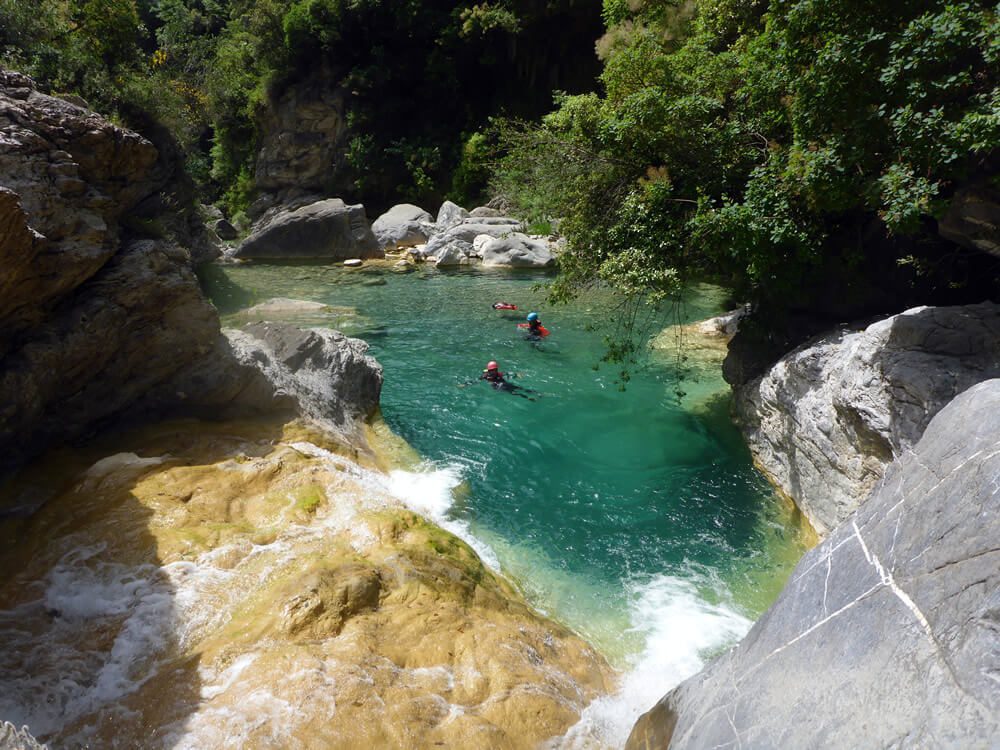
Choose canyoning shoes that grip wet limestone, drain fast, protect the ankle, and stay secure when you progress through water, gravel, abseils, and narrow rock passages. For most guided descents in the Alpes-Maritimes, trainers can work for easy routes, but dedicated footwear gives better control and peace of mind.
In canyoning, your feet do more than carry you. They help you cross slippery riverbeds, stand on wet limestone, land in a natural pool, and follow your guide through terrain that changes every few metres.
At Adrenaline 06, we guide canyoning in the Alpes-Maritimes with state-qualified guides or equivalent, and former trainers at the French national canyon rescue school for the fire service. We’ve specialised in canyoning in the Alpes-Maritimes for over 25 years, with routes around Nice, the French Riviera, and the Mercantour. This guide explains how to choose footwear with the same practical logic we use before a descent.
Why Footwear Matters More in A Canyon Than on A Hiking Trail
Canyoning footwear has to solve four problems at once: wet grip, drainage, impact protection, and stability on uneven limestone. A normal walking shoe may feel fine on the approach, but it can lose control quickly once you enter water, polished rock, and narrow channels.
A canyoning descent is not a dry walk with a few water crossings. You progress near water, on wet rock, and your footwear must help you stay calm.
Your guide will remind you: “You will walk along a river over wet, slippery rocks, so move carefully, do not run, and use your arms for balance.” It’s a practical reminder: choose shoes for the ground you will actually stand on.
What Changes Underfoot
Grip is universally recognised by professional guides as the most critical feature of a canyoning shoe. In plain English, wet-friction means how well the sole holds when both the rubber and the rock are wet. That matters more than comfort in the shop.
For accessible canyoning near Nice, the route may feel playful and refreshing, but the rock still asks for attention. Your choice of footwear changes how relaxed you feel before each step.
Canyoning Shoes vs Trainers: The Real Differences
Good canyoning shoes use specialist rubber, protective body construction, fast drainage, and a secure closure system. The aim is not to make the shoe look technical, but to keep the foot planted when water, sand, limestone, and rope work all happen in one descent.
Professional guides dictate that clients wear specialised canyoning shoes or strong approach shoes. Standard running shoes or hiking boots are frequently deemed insufficient because severe aquatic degradation and weak wet-friction can appear after only a few descents.
Key Features to Check
- Rubber compound: Vibram Idrogrip and Stealth Rubber are designed for wet rock traction.
- Drainage valves: These let water leave the shoe after a swim or pool exit.
- Rubber rand: This is the protective band around the shoe edge, useful in narrow rock slots.
- Toe cap: This protects the front of the foot when you hit submerged stone.
- Ankle hold: A higher collar or gaiter helps reduce gravel ingress and twisting.
- Closure system: Laces or covered lace systems must stay tight when soaked.
Sole And Upper Examples
Vibram IdroGrip is used by premium canyoning brands such as La Sportiva and Bestard. The La Sportiva TX Canyon uses Vibram IdroGrip, a climbing zone at the toe platform for edging, and a Spyral Collar designed to wrap around the ankle and limit gravel entry.
The Adidas Terrex Hydro Lace uses Stealth Rubber and an internal neoprene lining for warmth and fit. The Bestard Canyon Guide is a Spanish-made canyoning boot with a built-in gaiter, ankle support, and a Vibram Idrogrip sole.
When the sole is right, the body construction can do its job. When the sole is wrong, every careful movement takes more effort.
Which Shoe Type Should You Choose for Your Level?
Beginners on guided, accessible routes can often use strong trainers or approach shoes, while regular canyoners should consider dedicated canyoning shoes. Technical routes, repeated descents, and travel to Alpine canyons make purpose-built footwear a better investment.
Based on expert reviews and industry testing, three models dominate the European canyoning market: La Sportiva TX Canyon, Adidas Terrex Hydro Lace, and Bestard Canyon Guide. They’re not the only options, but they show the design direction of modern canyoning footwear.
Quick Decision Table
If you’re booking a first trip with Adrenaline 06, the simplest rule is this: don’t bring flat fashion trainers, smooth-soled shoes, or anything loose. Bring footwear that can get soaked, stay attached to your foot, and still grip wet stone.
For private groups or families, the same rule applies. A private canyoning vip outing can be adapted to the group, but unsuitable footwear still makes easy obstacles feel clumsy.
Once you know the right shoe category, the next decision is terrain. The Alpes-Maritimes has its own rock, water, and grading logic.
How the Alpes-Maritimes Changes the Footwear Decision
Canyoning near Nice, the Mercantour, and the French Riviera often combines limestone, clear water, short approach paths, and seasonal flow changes. Footwear should be chosen for wet limestone and movement in water, not only for the dry walk to the canyon.
A simple history of canyoning starts with a practical definition: canyoning is an outdoor sport that descends canyons, rivers and watercourses. That history matters because the activity is a mix of walking, swimming, sliding, jumping, and abseiling.
Local Factors to Consider
- Season: Canyoning in the Alpes-Maritimes is mainly a May to September activity.
- Water level: Adrenaline 06 stays attentive to water flow before choosing how a route should run.
- Weather: Weather conditions can change the character of a canyon.
- Rock: Wet limestone around the Gorges du Loup can be smooth and polished.
- Group type: Families, beginners, and sporty adults don’t need the same level of stiffness.
Weather And Flow Checks
For weather context, we use official vigilance and local condition checks from Météo-France (vigilance.weatherfrance.fr).
For regional risk information, the Alpes-Maritimes prefecture (alpes-maritimes.gouv.fr) is the public authority source.
Those checks don’t replace guide judgement, but they help explain why the same canyon can feel easy one week and more demanding after rain.
Fit After Water
A shoe that drains quickly helps after each pool. A shoe that holds the ankle helps when the canyon becomes more enclosed, or when you need to progress over blocks before the next natural pool.
That’s why shoe choice is part of preparation, not a last-minute packing detail.
For UK Visitors: Footwear Differences in France
UK visitors should compare their familiar gorge walking or ghyll scrambling experience with the French canyon grading system before choosing footwear. UKCA guidance and French V/A/I canyon grades both point to the same practical truth: slippery, aquatic terrain needs grip, ankle support, and careful preparation.
The UK Scout Association provides formalised definitions and safety parameters for gorge walking and ghyll scrambling, which are the domestic UK equivalents to international canyoning. The UKCA is the governing body that oversees training, safety, and certification for canyoning, gorge walking, and coasteering in the UK.
UK to France Translation
For UK practitioners planning trips to the French Alpes-Maritimes, understanding the intersection of UK training standards and French grading systems appears to be a key part of safe preparation. The UK Canyoning Association grading resource (ukcanyoning.org) describes levels where walking technique needs extra attention on slippery, unstable, uneven, constricted, or aquatic ground.
In that grading logic, a jump height, a swim length, or an abseil height changes the route. Footwear has to match those features, not just the holiday mood.
For a guided outing in the Alpes-Maritimes, we’ll help you choose a descent suited to your group. But arriving with secure footwear gives you a better start before the first step into the water.
Comparing Leading Models Without Gear Overload
When comparing canyoning shoes, focus on the sole, ankle design, drainage, and protection before colour, brand loyalty, or price. The right model is the one that matches your route frequency, water temperature, and need for support.
Online discussions can be helpful, but they often turn into brand preference. Reddit threads, Facebook comments, and short equipment lists may mention Adidas, La Sportiva, Five Ten, or Bestard without explaining when each type makes sense.
Model Comparison
Materials And Durability
Ariaprene is a modern, closed-cell synthetic foam used in some canyoning shoe uppers. In practical terms, closed-cell means it resists absorbing water, so the shoe doesn’t become heavy like a sponge.
The La Sportiva TX Canyon is marketed with eco materials from recycled raw materials, including 100% PFC-free water-repellent coatings, recycled polyester laces, and a compression-moulded EVA midsole with 7% recycled content. It is highly regarded for its eco-friendly construction, using 100% PFC-free materials and recycled laces.
Buying Guidance
That matters because a notable development in 2024 to 2025 has been the shift toward lower-impact manufacturing. Outdoor footwear is getting more technical, but it’s also being pushed to reduce chemical treatments and waste.
A good purchase is one you’ll use often enough to justify. If you’re unsure, ask your guide before buying.
Market Data From 2024 to 2026 and Better Gear
The canyoning footwear market is improving because adventure travel demand is rising and manufacturers are investing in wet-grip safety, drainage, and more durable materials. That growth doesn’t mean every beginner needs expensive footwear, but it explains why modern shoes are better than old all-purpose options.
According to global travel data, global leisure tourism spending reached approximately £4.2 trillion in 2024, a 24% increase over 2019 levels. The global adventure sports and activities market size was valued at USD 239.56 billion in 2024 and expanded to USD 249.67 billion in 2025.
Market Context for Canyoning Gear
Projections indicate a continued upward trajectory, reaching an estimated USD 260.21 billion in 2026, with a Compound Annual Growth Rate of 4.22% extending toward 2034, according to Straits Research (straitsresearch.com). Within this broader market, the specific canyoning tourism market was valued at approximately USD 0.6 billion to USD 0.9 billion in 2025, with some reports projecting USD 1.7 billion by 2034 at 7.2% CAGR.
For Adrenaline 06 and other professional guiding bureaus, technological advances in footwear materials have stimulated product upgrades among recreational users and guides. Better drainage, stronger rands, and safer wet-grip compounds reduce small slips and make long aquatic sections less tiring.
The market data doesn’t choose your shoe. It explains why there are now more reliable options than the generic outdoor footwear many people used ten years ago.
Our Practical Shoe Checklist Before You Book
Before booking a canyoning outing, check whether your footwear holds the heel, grips on wet stone, drains water, protects the toes, and can be soaked without damage. If one of those answers is no, choose a stronger shoe or ask your guide what to bring.
For beginner-friendly canyoning in the Alpes-Maritimes, we keep the advice simple. Bring a swimwear, a towel, a dry change of clothes, secure footwear, and a sports strap for glasses if needed.
Five Checks Before the Descent
- Sole test: The outsole should feel textured, not smooth or worn flat.
- Heel hold: Your heel shouldn’t lift when the shoe is wet.
- Toe protection: The front should protect against submerged stone.
- Drainage: The shoe shouldn’t trap water after each pool.
- Closure: Laces or straps should stay secure during movement.
If you’re bringing trainers, choose the pair with the best grip, not the pair you mind least about getting wet. We don’t recommend fragile fashion shoes, sandals without foot hold, or hiking boots that become heavy in water.
Ask Before You Arrive
For guided trips, Adrenaline 06 keeps the route choice, weather, water flow, and group profile in view. Thomas Auvaro, UIAGM high mountain guide, former member of the GMHM, brings that mountain judgement into the canyon, with peace of mind and expert guidance.
For questions before a May to September outing near Nice, contact Adrenaline 06 via WhatsApp, phone or email. We’ll help you check whether your footwear is suitable before you set off. The phone number is +33 6 62 03 96 20.
FAQ
Use these quick answers as a final check:
- For a first guided outing, don’t bring smooth fashion trainers, loose sandals, or heavy hiking boots.
- For regular canyoning, dedicated shoes are worth considering because better grip, drainage, and ankle hold make each movement calmer.
What Shoes Should I Wear in Canyoning?
Wear secure trainers, approach shoes, or dedicated canyoning shoes with strong wet grip, toe protection, and a closure that stays tight in water. For easy guided routes, strong trainers can be enough. For regular descents, choose specialist footwear with drainage, ankle hold, and a sole designed for wet limestone.
What Are the Best Shoes for Canyoning?
The best shoes for canyoning are models that combine wet-friction rubber, ankle support, drainage, and strong body construction. In European canyoning, La Sportiva TX Canyon, Adidas Terrex Hydro Lace, Five Ten Canyoneer, and Bestard Canyon Guide are frequent reference models, each suited to different levels of use.
What is the 3 Shoe Rule?
The 3 shoe rule means checking three practical shoe qualities before entering the canyon: grip, protection, and retention. The shoe must grip wet rock, protect toes and ankles, and stay attached during swimming, sliding, walking, and abseil starts. If one part fails, choose another pair.
What to Wear While Canyoning?
Wear swimwear under the canyoning equipment, secure footwear, and bring a towel plus dry clothes for after the outing. The guide provides the technical equipment for the descent. If you wear glasses, use a sport cord so they stay attached during water sections and natural slides.
Do UK Visitors Need Different Footwear in the Alpes-Maritimes?
UK visitors don’t need a separate category of footwear, but they should respect the difference between UK gorge walking and French canyon grading. Routes in the Alpes-Maritimes can include wet limestone, abseils, deeper pools, and longer aquatic progressions, so high-grip footwear is a sound choice.
If you’re planning a canyoning outing around Nice, the French Riviera, or the Mercantour, choose footwear that keeps you steady before you think about speed. Contact Adrenaline 06 via WhatsApp, phone or email, and we’ll help you prepare for the right descent in the Alpes-Maritimes.