
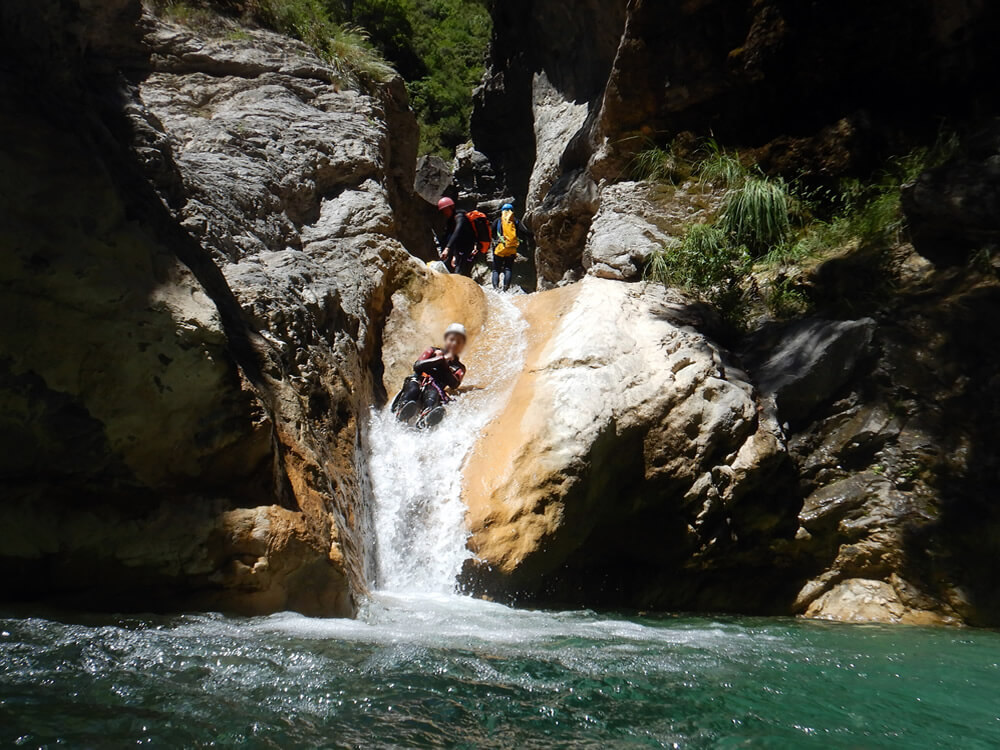
When you book a canyoning trip in the Gorges du Loup, the list of things you need to bring is shorter than most people expect. Your guide provides the technical protective equipment. Your job is to arrive with the right personal items, suitable trainers, and the travel insurance cover you need for an outdoor activity in France.
Adrenaline 06 is a specialist in canyoning in the Alpes-Maritimes, with the Auvaro family guiding in the region for over 25 years. Our guides are state-qualified or equivalent, and groups are limited to 8 people. This guide explains what to bring, what to leave at home, and what we provide on the day.
What You Do Not Need to Bring
You do not need to buy technical canyoning equipment before your trip. Adrenaline 06 provides the protective equipment needed for the descent, including the wetsuit, helmet, harness, ropes and collective safety equipment used by the guide.
This matters because canyoning equipment is specific. A canyon harness is not the same as a basic climbing harness, and canyon ropes are selected for wet, abrasive limestone environments.
What we provide:
- Neoprene wetsuit adapted to the conditions
- Helmet
- Canyoning harness with descender and lanyards
- Neoprene socks when required
- Collective ropes and guide equipment
- First-aid and communication equipment managed by the guide
You should not rent random gear in town or buy second-hand equipment without knowing its history. Canyoning kit must be checked, tracked and retired at the right time.
What You Should Bring
For a standard canyoning outing, bring swimwear, a towel, dry clothes for after the descent, trainers that can get wet, and a sports strap if you wear glasses. Keep the personal list simple.
You will get changed before the activity and again afterwards. The aim is to arrive ready, not overloaded.
Bring:
- Swimwear to wear under the wetsuit
- A towel
- Dry clothes for after the activity
- Trainers with laces and a secure sole
- A sports strap if you wear glasses
- Water and a small snack for after the descent
Do not bring valuables into the canyon. Phones, wallets, passports and car keys should stay where the guide tells you to leave them.
Why Trainers Matter
Shoes are the item people get wrong most often. Beach shoes, flip-flops and smooth-soled shoes do not belong in a canyon.
You need trainers because the route includes wet limestone, short walks, river crossings, natural rock slides and uneven ground. The sole must grip, and the shoe must stay on your foot in moving water.
Good canyoning trainers should have:
- Laces or a secure fastening
- A sole with real grip
- Enough support for uneven rock
- No loose straps
- No smooth beach-shoe sole
They will get wet. That is normal.
The Equipment We Provide
The guide’s equipment does two jobs: it keeps you warm enough in cold water and gives the guide the right tools to manage ropes, group movement and canyon-specific obstacles.
Even in summer, the water in the Gorges du Loup can feel cold because the canyon is fed by underground sources. The air can be hot on the Côte d’Azur while the water remains fresh inside the gorge.
Wetsuit and Thermal Comfort
The wetsuit helps your body manage repeated immersion. You may be walking in the sun one moment and swimming in shaded water the next.
This is why we provide canyoning wetsuits adapted to the route and the conditions. You do not need to choose or buy one before you arrive.
Harness, Ropes and Descender
The harness, ropes and descender are used for abseils, hand lines and controlled movement through steeper sections. These are handled under the guide’s instruction.
Canyoning equipment is chosen for wet rock, moving water and repeated contact with limestone. A normal outdoor activity kit is not a substitute for professional canyoning equipment.
Travel Insurance and GHIC
If you are travelling from the UK, check that your travel insurance covers canyoning or adventure sports. A GHIC card does not replace insurance for rescue, repatriation or private medical costs.
The GHIC can help with access to medically necessary state healthcare in France, but it is not a full adventure travel insurance policy. It does not mean every rescue or medical cost is covered.
Before you travel, check whether your policy includes:
- Canyoning or adventure sports cover
- Medical treatment after an outdoor accident
- Rescue and evacuation where required
- Repatriation
- Cancellation if your trip cannot go ahead for covered reasons
If the policy wording is unclear, contact the insurer before your trip. Do not assume canyoning is covered because swimming or hiking is covered.
Why Book With Adrenaline 06
Adrenaline 06 keeps the experience practical, guided and reassuring: small groups, professional equipment, local canyon knowledge, and guides who are trainers, not just activity escorts.
The team includes guides who are state-qualified or equivalent and former trainers with the École nationale de secours en canyon des Sapeurs-Pompiers. Thomas Auvaro is a Guide de Haute Montagne UIAGM and a former member of the GMHM, the French military high-altitude alpinism group.
These credentials matter because canyoning is not just about following a route. The guide reads the group, the weather, the water level and each obstacle.
For practical questions before booking, contact Adrenaline 06 by WhatsApp, phone or e-mail.
Frequently Asked Questions
What should I bring canyoning?
Bring swimwear, a towel, dry clothes for after the trip, trainers with laces, and a sports strap if you wear glasses. Your guide provides the technical canyoning equipment.
What equipment do you need for canyoning?
Technical canyoning equipment includes a wetsuit, helmet, harness, ropes and descender. With Adrenaline 06, this equipment is provided for your guided outing.
What clothes should I wear for canyoning?
Wear swimwear under the wetsuit. After the descent, you will want a towel and dry clothes.
What shoes do I need for canyoning?
Wear trainers with laces and a grippy sole. Do not wear flip-flops, beach shoes or smooth-soled footwear.
Do I need to know how to swim?
Yes, you should be comfortable in water. Beginner routes are guided and adapted, but canyoning is still an aquatic outdoor activity.